REVIEW · HO CHI MINH CITY
Explore HCMC by US Army Jeep: History & Food
Book on Viator →Operated by Vietnam Tours VIP · Bookable on Viator
A vintage US Army jeep gives you a new angle.
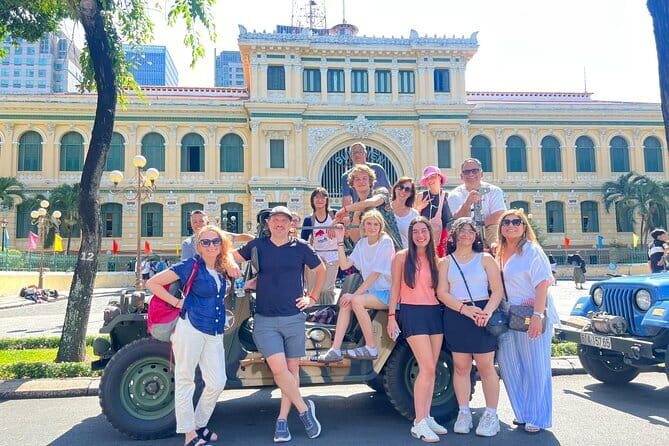
This private half-day loop mixes French colonial landmarks, Vietnam War-era stops, and a live look at lacquer artists, all from an open-air ride. I like that it packs big, meaningful sites into about 4 hours without feeling rushed between neighborhoods.
What I really like is the pairing of motion and context. You’re rolling through the city while an English-speaking guide connects what you see to what Saigon was going through—plus you get stops that actually let you go inside, like Reunification Palace and the War Remnants Museum.
One thing to consider: the route includes open-air driving. If you’re sensitive to sun, heat, or sudden rain, bring a hat and light rain cover so the ride stays enjoyable.
In This Review
- Key highlights you’ll feel on the ride
- How an open-air US Army jeep changes Ho Chi Minh City
- Pickup, timing, and how the 4-hour loop is paced
- Why $69 feels like real value for this private format
- French colonial Saigon: Opera House, Notre-Dame, and Dong Khoi
- Reunification Palace: the wartime pivot you can walk through
- Central Post Office break: history you can use, not just look at
- Nguyen Hue Street, Bitexco tower, and the city’s modern edge
- Jade Emperor Pagoda: a Taoist pause during the war-heavy part
- Former U.S. Embassy and War Remnants Museum: how the tour tells the story
- Sơn mài Đại Việt lacquer artists: souvenirs with a story attached
- Who should book this Jeep tour, and who should skip it
- Should you book the US Army Jeep History & Food tour?
- FAQ
- How long is the Ho Chi Minh City Jeep tour?
- What does the tour cost?
- Do I get picked up in Ho Chi Minh City?
- Is the jeep open-air?
- Do I need a Vietnamese guide?
- Are entrance fees included?
- Is bottled water included?
- Is this tour private?
- Where do I end the tour?
- Can I cancel for a refund?
Key highlights you’ll feel on the ride
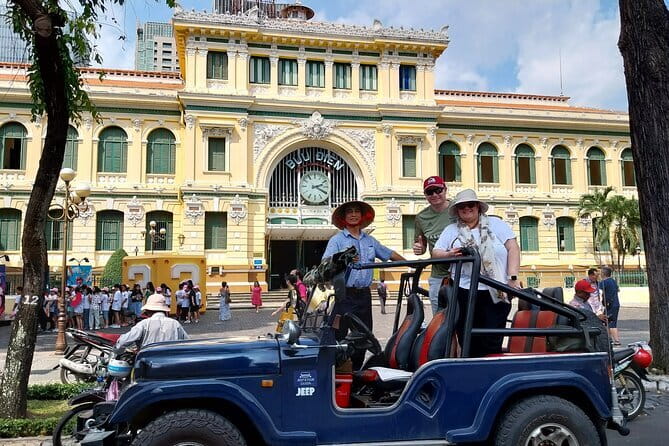
- Open-air former Jeep for big views and classic Saigon street energy
- Private tour means only your group, not a mixed crowd
- Included entry tickets plus bottled water
- Live lacquer craftsmanship at Sơn mài Đại Việt, where souvenir shopping makes sense
- War Remnants Museum and the former U.S. Embassy stop for real context
- Friendly, story-driven guiding with examples like Luc, Phat, Nam, Thong, Khoa, Ngoc, Trung, Thuy, and Nhat
How an open-air US Army jeep changes Ho Chi Minh City

Ho Chi Minh City is visual. Streets are wide, motorbikes weave fast, and the buildings jump between old French faces and newer glass towers. A regular car can make it feel like scenery. This tour uses a vintage open-air jeep, so the city hits you in real time—sounds, motion, and quick sightlines that you miss when you’re sealed in.
The best part is that the vehicle matches the story. This is a city that carries layers: colonial planning, wartime scars, and postwar change. Rolling past landmarks while your guide explains what happened around each one makes the whole day feel like one connected timeline, not a checklist.
Also, you’ll get more photos than you think. With an open vehicle, you can frame building fronts and street scenes without guessing your angle from a back seat.
You can also read our reviews of more food & drink experiences in Ho Chi Minh City



Pickup, timing, and how the 4-hour loop is paced
The tour runs about 4 hours. That matters because you’re covering multiple districts, not just one compact area. The itinerary is built so you can stop, walk a bit, go inside key places for set times, then move on.
Pickup is offered in District 1 hotels. You can also be dropped back at your hotel or at Ben Thanh Market at the end, which is convenient if you want to keep exploring afterward on your own.
One timing detail that’s worth knowing: the remaining time is allotted for travel. That means some stops are shorter than you might expect, while indoor sites get the time they need. For example, Reunification Palace is given 30 minutes with an admission ticket included, and the War Remnants Museum gets 40 minutes. That’s enough to see the main ideas without turning the tour into an all-day marathon.
Practical tip: wear comfortable shoes. Even on a short tour, you’re stepping in and out of busy areas and walking inside historic buildings.
Why $69 feels like real value for this private format
At $69 per person, the big question is what you get for the money. Here’s what’s included that tends to add up fast on your own:
- English-speaking tour expert
- Open-air former Jeep
- Entrance fees (for the stops where tickets are required)
- Bottled water
- Pickup/drop-off in District 1
- Private experience for your group only
The value here is not just the price. It’s how the inclusions reduce decision fatigue. You’re not sorting out tickets and transport between locations. You’re also not paying for a separate guide at each stop.
If you’re traveling with one or two people, private format can be a strong deal compared with piecing together taxis plus a guide plus admissions. If you’re traveling solo, it’s still a manageable cost for a full half-day because you’re getting transport and multiple entrances bundled together.
French colonial Saigon: Opera House, Notre-Dame, and Dong Khoi
Your ride starts in the downtown historic zone with a stop at the Saigon Opera House, an architectural landmark built in 1897 by French architect Eugène Ferret. Even if you only pause briefly, it helps set the tone: this city didn’t just develop over time; it was planned and reshaped by outside influence.
From there, the route brings you to Notre-Dame Cathedral Basilica of Saigon, built between 1877 and 1880 by French colonists. It’s the kind of place where you’ll see tourists for a reason: the exterior is striking, and it’s easy to understand how this kind of architecture was used to signal power and permanence.
Next is Đồng Khởi Street, known for French colonial-era architecture and its role as one of the city’s historic thoroughfares. This isn’t about one building—it’s about the street “feel.” Your guide can help you read the layers in the facades and alignments while you’re moving through.
What to watch for: short photo windows. These stops are not designed for long wandering, so if you want the best shots, stand where you can keep moving with the group when it’s time to reboard.
Reunification Palace: the wartime pivot you can walk through

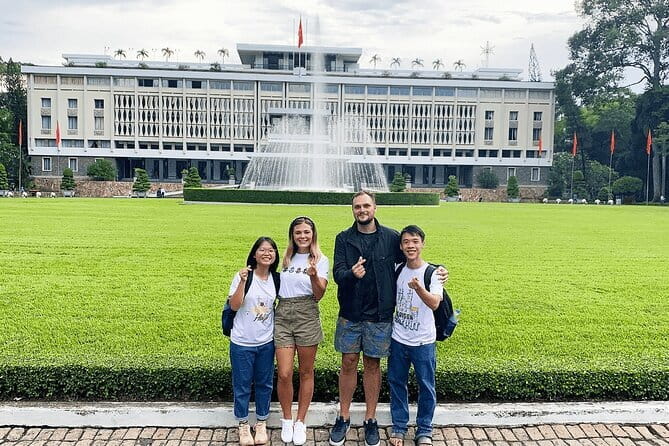
The Reunification Palace (also known as Independence Palace) is a major anchor on this tour. The visit is 30 minutes with an admission ticket included, which is a solid chunk for a place that tells a lot without requiring a full day.
This stop matters because it’s not a monument that only sits in the distance. It’s tied to Vietnam’s turbulent history, and it’s described as a powerful symbol of resilience. The architecture is part of the story too—an “administrative and power” kind of space that helps you understand why certain locations become targets and symbols during conflict.
A practical note: if you’re the kind of person who reads every placard, 30 minutes may feel tight. If you focus on the big rooms and the overall narrative, it works well inside a half-day plan.
You can also read our reviews of more tours and experiences in Ho Chi Minh City





Central Post Office break: history you can use, not just look at

The tour also includes the Saigon Central Post Office. You get about 10 minutes, with an admission ticket included.
This stop can be a nice palate cleanser after Reunification Palace and before you move back into street scenes. The post office is a functional space, so it doesn’t feel like you’re only viewing an exhibit. Think of it as architecture with daily life around it, which is often a better memory than yet another empty hall.
One detail from the tour description that’s worth leaning into: it’s positioned as a place where history and everyday routines meet, so you can use the short time to check the surroundings and reset your brain before the next wave of landmarks.
Nguyen Hue Street, Bitexco tower, and the city’s modern edge

From colonial downtown you shift toward the broader city center. Nguyễn Huế Street (Nguyễn Huế Boulevard) is a pedestrian-focused zone known for its wide, tree-lined layout and street energy. It’s the kind of place where you can feel how the city organizes public space today.
Then you reach Bitexco Financial Tower, listed at 262.5 meters (861 feet). This is your reminder that Ho Chi Minh City didn’t just preserve old layers—it built upward as the economy changed. Your guide can help you interpret why this tower is more than a skyline selfie point.
The route also includes Ba Son Bridge (also known as Thu Thiem 2 Bridge). It connects District 1 with the Thu Thiem New Urban Area in District 2. Even if you only get a brief stop, it helps you understand the city’s expansion logic: bridges aren’t just engineering; they’re how neighborhoods start operating as one larger system.
Photo tip: for towers and bridges, bring your phone in a stable grip. The jeep moves, and you’ll want clean shots without fighting the camera shake.
Jade Emperor Pagoda: a Taoist pause during the war-heavy part
After the modern stretch, the itinerary turns to a very different tone with the Emperor Jade Pagoda (Chùa Ngọc Hoàng), built in 1909. This Taoist temple is dedicated to the Jade Emperor, described as the King of Heaven in Chinese mythology.
A 20-minute visit gives you enough time to walk the space and notice the details without rushing through it. This is one of the best stops on the tour for balance: after palaces and war-era memory, you get a place where beliefs are expressed through worship rituals and temple design.
What I’d do if you’re curious but not sure what to look for: pay attention to how people move through the space and where offerings are placed. Your guide can usually connect what you’re seeing to the meaning behind the temple’s dedication.
Former U.S. Embassy and War Remnants Museum: how the tour tells the story
The tour includes the former U.S. Embassy in Saigon, now in Ho Chi Minh City, located at 4 Lê Duan Boulevard. The description frames it as a significant Vietnam War-era site tied to American involvement.
Then you visit the War Remnants Museum, open 40 minutes with an admission ticket included. The museum is described as a profound look at Vietnam’s turbulent history, established in 1975, showing the impact of the war.
This is the emotional center of the tour, even if you’re not a museum person. A museum can feel heavy. What makes this stop work in a jeep tour is the lead-in: you’ve already seen political power sites and major city transitions, so the museum doesn’t land out of nowhere.
Consider pacing yourself. If you tend to feel overwhelmed by graphic images or intense content, you might want to focus on specific sections the guide highlights, rather than trying to see everything at once.
Sơn mài Đại Việt lacquer artists: souvenirs with a story attached
One of the most praised parts is the stop at Sơn mài Đại Việt (Dai Viet Lacquerware Factory). You get 30 minutes with an admission ticket included.
In the feedback, watching the lacquer artists at work is described as a highlight. That matters. Buying a souvenir in a market is one thing; buying something you saw being made in front of you is another. You can ask questions and connect the product to a process—how the craft is done, what materials are used, and why lacquer work takes patience.
This is also where your guide can be especially useful. Since you’re with an English-speaking tour expert, you can get practical guidance before you buy—like what’s worth your money and how to choose pieces that travel well.
What to bring: if you’re planning to shop, keep some cash or a payment method ready. You won’t want to be forced into buying only from whatever fits your wallet that day.
Who should book this Jeep tour, and who should skip it
This tour is a great fit if you:
- Want a half-day way to see major landmarks without coordinating transport
- Like history that’s explained in plain language while you’re moving through real streets
- Enjoy photography from an open-air vehicle
- Want one memorable culture stop beyond the “big ticket” sites (Sơn mài Đại Việt is that)
You might want to choose a different format if:
- You’re very weather-sensitive, since the ride is open-air
- You prefer slow museum time, since some stops are intentionally short to fit the route
If you’re in Ho Chi Minh City for a tight schedule, this gives you a high-impact sweep across colonial downtown, modern growth areas, and war-era memory.
Should you book the US Army Jeep History & Food tour?
If you want value plus a fun way to connect the dots, I’d book it. The included entrance tickets, bottled water, and District 1 pickup/drop-off make it easier to plan than DIY. The open-air jeep adds a real “you’re in the city” feeling, not just a bus tour vibe.
My final nudge: go in with a flexible mindset. This is a half-day tour, so you won’t linger at every stop. But if you’re happy to see the big themes—colonial architecture, war-era sites, a Taoist temple pause, and live lacquer craft—this one is built to work.
FAQ
How long is the Ho Chi Minh City Jeep tour?
It’s about 4 hours.
What does the tour cost?
The price is $69.00 per person.
Do I get picked up in Ho Chi Minh City?
Yes, pickup is offered from hotels in District 1.
Is the jeep open-air?
Yes. You ride in an open-air former Jeep.
Do I need a Vietnamese guide?
No. The tour includes an English-speaking tour expert.
Are entrance fees included?
Yes. Entrance fee(s) are included (where tickets are required for the stops).
Is bottled water included?
Yes, bottled water is included.
Is this tour private?
Yes. It’s private, so only your group participates.
Where do I end the tour?
You’ll be dropped off back at your hotel or at Ben Thanh Market.
Can I cancel for a refund?
Yes. You can cancel up to 24 hours in advance for a full refund. If you cancel less than 24 hours before the start time, the amount paid is not refunded.