REVIEW · HO CHI MINH CITY
Saigon On 2 Wheels
Book on Viator →Operated by Ho Chi Minh Scooter Tour · Bookable on Viator
Ho Chi Minh City moves fast, and this ride helps you keep up. I like that Saigon On 2 Wheels turns a confusing maze of streets into a short, guided loop with real city sights plus quieter stops you’d miss on foot. It’s built for 3–4 hours of maximum payoff without spending your day zigzagging on your own.
Two things I’d pick this for: the English-speaking guides (I’ve seen names like Yang, Paul, Binh, and Ninh attached to these tours, and the vibe is friendly and flexible) and the practical kit—scooter plus a high-quality helmet. You get structure, but you’re not stuck in a stuffy bus schedule.
One consideration: pickup is not universal. Free pickup/drop-off is only for hotels in District 1 and District 3, with an extra $3–$5 for others, so if you’re outside those areas, I’d confirm the meeting plan before you arrive.
In This Review
- Key points that matter before you ride
- A scooter-led loop that makes Saigon feel manageable
- Stop 1: Thich Quang Duc Monument sets the tone fast
- Stop 2: Ho Thi Ky Flower Market smells like everyday life
- Stop 3: Ba Thien Hau Temple in Cholon adds a different belief world
- Stop 4: Notre-Dame Cathedral Basilica gives you the French-colonial contrast
- Stop 5: Central Post Office turns architecture into a time machine
- Stop 6: Independence Palace is the war-era anchor (and the one paid entry)
- Stop 7 and 8: Ben Thanh Market and the Saigon Opera House
- What the scooters and helmets really mean for you
- Price check: is $15 good value?
- How guides shape the experience on a bike tour
- Logistics and timing: when this tour fits best
- Who should book Saigon On 2 Wheels?
- Should you book? My take
- FAQ
- How much does Saigon On 2 Wheels cost?
- How long is the tour?
- What’s included in the price?
- Is pickup and drop-off included?
- Do I need to pay for Independence Palace?
- Where does the tour start and end?
- What weather requirements affect the tour?
Key points that matter before you ride
- Small group size (max 10) means you’re less likely to feel like a number while weaving through traffic.
- English-speaking guidance keeps the meaning of each place clear, not just the photo spot.
- Free entry for most stops helps your money go further, with Independence Palace entry as the main exception.
- Scooter time is the point here: you’ll cover major landmarks and a couple of local-market vibes in a few hours.
- Pickup is limited by district, so location matters if you want the convenience.
A scooter-led loop that makes Saigon feel manageable
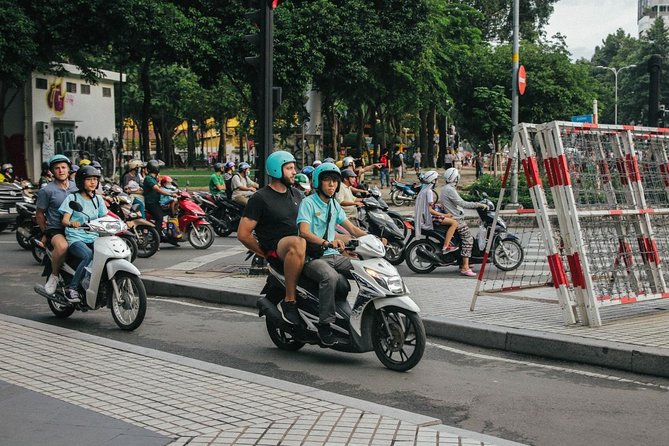
Ho Chi Minh City is exciting, but it can also be a lot—noise, motorbikes, and constant motion. This tour is designed to compress the essentials into a short window, so you come away with both big-name landmarks and the kind of streets-and-stalls energy that defines the city.
The format is simple: you’re on a scooter for most of the experience, following a guide through the city’s rhythm. In a few hours, you’ll touch several very different Saigon worlds—religious sites, a flower market, French colonial icons, and war-era landmarks—without trying to map everything yourself.
At $15 per person for a 3–4 hour guided scooter ride, this is the kind of value option that works best when you want direction and don’t want to waste your first or second day figuring out routes.
You can also read our reviews of more tours and experiences in Ho Chi Minh City.



Stop 1: Thich Quang Duc Monument sets the tone fast
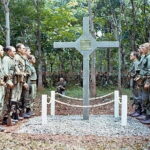
You start at the Venerable Thich Quang Duc Monument, a memorial to the monk who set himself on fire in protest of the persecution of Buddhists in Vietnam. The point of this stop is not sightseeing for sightseeing’s sake—it’s a reminder that Saigon’s story includes serious moral and political turning points.
Plan on about 15 minutes here. It’s enough time to understand what you’re looking at and to get the emotional weight of the memorial before the tour shifts into more everyday city scenes.
A practical note: because this is a meaningful memorial, I’d keep your phone camera ready but respectful. It’s the kind of stop where a quiet minute helps you absorb what you’re seeing.
Stop 2: Ho Thi Ky Flower Market smells like everyday life
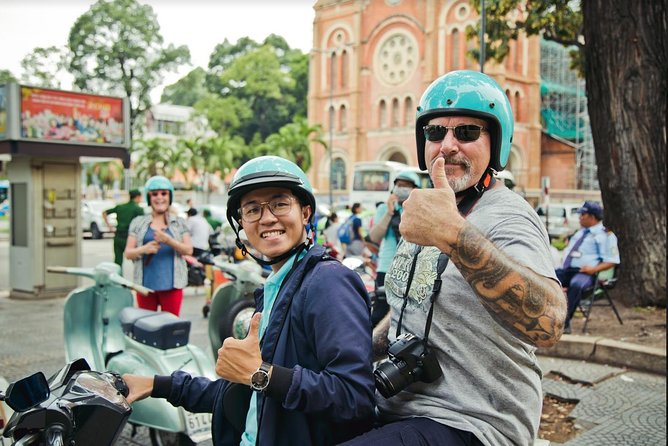
Next comes Ho Thi Ky Flower Market. This is where you see the city’s demand for fresh color and ritual flowers up close—chrysanthemum, marigold, gerbera, orchid-style arrangements, roses, sunflower, and more. Flowers may come from Dalat, Hanoi, and even international sources, and you may also notice other items sold alongside blossoms.
This stop is also about 15 minutes, so think of it as a quick sensory hit rather than a slow browse. The value is how it grounds the tour in daily Saigon commerce—very different from the monument you saw first.
If you love markets, this is a good reminder that Saigon isn’t only about monuments and museums. People live here. They shop here. They celebrate and work here.
Stop 3: Ba Thien Hau Temple in Cholon adds a different belief world

From there you head to Ba Thien Hau Temple, located in Cholon (Chinatown) in District 5. The temple is dedicated to the Chinese sea goddess Mazu, believed to protect and rescue people at sea. You’ll also hear that Mazuism blends ideas connected to Taoism and Buddhism.
The stop runs about 15 minutes. It’s short, but it’s long enough to understand the basics: why this goddess matters to the community and why the temple has its own distinct atmosphere.
This is one of those stops where the guide’s explanation really matters. Without context, you can still enjoy the architecture and setting, but with context you start noticing what the symbols and traditions are trying to tell you.
Stop 4: Notre-Dame Cathedral Basilica gives you the French-colonial contrast
Then you arrive at Saigon Notre Dame Cathedral Basilica, built between 1863 and 1880 by French colonists. Modeled on Notre-Dame de Paris and made with materials shipped from France, it became a major religious center for Vietnam’s Catholic community.
This also gets about 15 minutes. The short duration is intentional: it’s a landmark stop, not a long-church visit. You’ll likely appreciate the exterior and key interior details, and you’ll get the contrast between colonial-era architecture and the modern city surrounding it.
If you’re the type who likes comparing styles, this is a strong moment. It helps you see why Saigon’s physical look isn’t one single story—it’s layers.


Stop 5: Central Post Office turns architecture into a time machine
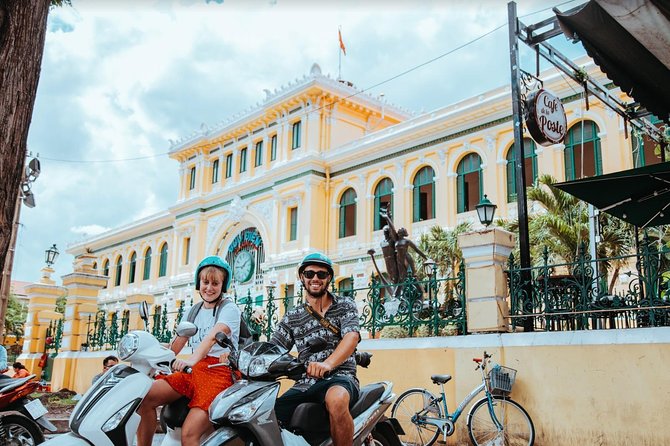
The Central Post Office in Ho Chi Minh City was constructed between 1886 and 1891, and once inside you can see the looping arches, marble floors, and old-style telephone boxes. There are also maps painted above that hint at how communication worked before email and mobile phones, including telegraph lines across Vietnam and Cambodia.
You’ll spend about 15 minutes here. What makes this stop work on a scooter tour is that it doesn’t feel like a random detour. It connects with a very specific theme: how places once connected people over long distances.
There’s a reminder of local identity too—Ho Chi Minh’s portrait is prominently displayed high above. It’s a neat moment to see that the building is French in form, but the message is unmistakably Vietnamese.
Stop 6: Independence Palace is the war-era anchor (and the one paid entry)
Independence Palace is the tour’s heavy-hitting landmark. Built on the site of the former Norodom Palace, it served as the home and workplace of the President of South Vietnam during the Vietnam War. It’s also associated with the end of the war on 30 April 1975, when a North Vietnamese tank crashed through the gates.
This stop is about 10 minutes on the schedule, and—important—entry to Independence Palace is not included in the tour price. So if this is a top must-see for you, plan your budget for the extra ticket.
Because your time inside is limited, I’d treat this like a quick orientation to the site’s significance. If you want a slower, deeper visit, you may want to plan a separate visit later. But for a scooter tour that’s trying to cover a lot, this short stop still gives you the big-picture meaning.
Stop 7 and 8: Ben Thanh Market and the Saigon Opera House
The experience can end in one of two ways. You can finish at Ben Thanh Market, or you can be taken back toward your hotel with arrangements made in advance.
Ben Thanh Market gets about 5 minutes, so it’s a quick taste rather than a full shopping session. Still, it helps you finish on something lively and practical—a place where you can pick up snacks, souvenirs, or just watch city life wind down (or ramp up).
The tour can also include a stop at the Saigon Opera House (Ho Chi Minh Municipal Theater), a French Colonial architecture landmark. This tends to be around 10 minutes. Even if you don’t plan to catch a performance, seeing this building from the outside gives you another angle on Saigon’s layered architecture.
What the scooters and helmets really mean for you
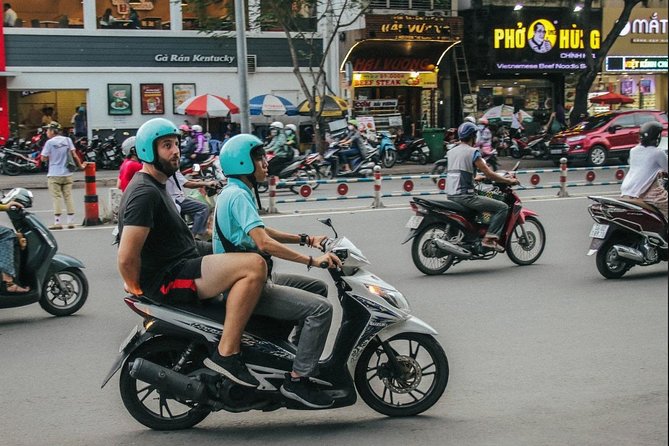
Riding a scooter in a major city is part of the appeal, and it also sets the tone for how the tour feels. With a scooter and a high-quality helmet included, you’re not left hunting for gear at the last minute. The tour guide drives the route decisions, which matters in a city where street patterns and traffic behavior can feel overwhelming.
Because the tour runs about 3–4 hours, you’re getting enough riding time to cover multiple districts without exhausting yourself. You’ll likely feel like you’ve seen “more than your own two feet could do,” which is exactly the point of this format.
Also, with a maximum of 10 travelers, you should be able to stay grouped up and follow instructions easily. That’s a big deal when the streets are busy.
Price check: is $15 good value?
At $15 per person, this is priced like a budget-friendly way to see major sights quickly. What boosts the value is what’s included: the scooter, helmet, and an English-speaking guide.
Then there’s the savings angle. Most stops are marked as free admission, including the Thich Quang Duc Monument, flower market, temple, Notre Dame Cathedral, Central Post Office, and Saigon Opera House. The main paid exception is Independence Palace, plus any pickup/drop-off charges if you’re outside District 1 and 3.
So the real cost equation is:
- Base price is low.
- You only expect one major extra ticket (Independence Palace).
- Your pickup district may add $3–$5.
That’s strong value if you want a structured highlights plan without paying for a full-day private car.
How guides shape the experience on a bike tour
A scooter tour lives or dies by its guide. The best tours don’t just point; they explain. Names like Yang and Paul and Binh and Ninh have been associated with these tours, and the consistent theme is that they’re engaging and willing to keep things light while still covering the essentials.
That matters because this route includes emotionally heavy sites (Thich Quang Duc Monument) and cultural context stops (Ba Thien Hau Temple). You want your guide to connect what you see to why it matters.
It also helps that the guide approach is described as flexible. On a city day, flexibility is what keeps your schedule from feeling like a checklist.
Logistics and timing: when this tour fits best
This is a great choice if you want to get oriented quickly—especially on your first few days. You’ll cover major city anchors (French colonial landmarks, a central post office, war-era symbolism) and also spend time in places that feel more local (flower market, Cholon temple).
The duration—3–4 hours—is long enough to feel like a real activity but short enough that you can still plan dinner or a second round of wandering afterward. If you’re trying to see Saigon without building your whole day around one museum, this timing is a good match.
If you’re sensitive to traffic noise or prefer quiet, you may find scooter noise and motion tiring. But if your travel style is active and you like city energy, this tour suits that perfectly.
Who should book Saigon On 2 Wheels?
Book it if you:
- want a fast, guided way to see multiple major landmarks in one morning or afternoon
- like learning context while moving through neighborhoods
- prefer scooter travel to buses or taxis for short distances
- can handle a short visit at heavy landmarks like Independence Palace
Consider another plan if you:
- need long, slow museum-style visits (Independence Palace is brief here)
- are depending on pickup and your hotel is outside the free pickup districts without time to confirm details
- don’t enjoy scooter rides in busy city traffic
Should you book? My take
If you want a practical, guided “starter kit” for Ho Chi Minh City, this is a smart booking. The $15 price is hard to beat for what’s included, and the fact that most stops have free entry means you’re not getting nickel-and-dimed into higher costs.
My only hesitation is the pickup coverage. If free pickup matters to you, double-check your district and plan to be at the right meeting point if needed. If you can handle that, you’ll likely end the ride with a clearer sense of how Saigon fits together.
FAQ
How much does Saigon On 2 Wheels cost?
The price is $15.00 per person.
How long is the tour?
It runs about 3 to 4 hours.
What’s included in the price?
Included are a friendly English-speaking guide, a motorbike/scooter, and a high-quality helmet.
Is pickup and drop-off included?
Free pick up and drop off is offered only for hotels in District 1 and District 3. For hotels outside those districts, extra $3–$5 may apply.
Do I need to pay for Independence Palace?
Entry to Independence Palace is not included.
Where does the tour start and end?
The tour starts at the War Remnants Museum. It ends back at the meeting point, though you can also arrange to finish at Ben Thanh Market or at your hotel.
What weather requirements affect the tour?
The experience requires good weather. If it’s canceled due to poor weather, you’ll be offered a different date or a full refund.